
 Hydrogen sulfide (H2S) is a colorless, flammable gas that is hazardous to both people and the environment. When exposed to even low levels of H2S, people can experience eye irritation, a sore throat, cough, shortness of breath, and fluid in the lungs.
H2S gas is commonly formed during warm weather when runoff from coal mines with high sulfate concentrations mix with water from lake bottoms. In northeast Ohio, many of the Muskingum reservoirs have become problem areas for emitting H2S gases as a result of improper restoration of strip-mined land prior to the Surface Mining Control and Reclamation Act of 1977.
Hydrogen sulfide problems exist at Tappan, Atwood, Leesville, Piedmont, and Clendening reservoirs. Warning signs have been posted in several areas advising the public to stay away. The US Army Corps of Engineers has studied the issue at length and has identified solutions that should minimize or eliminate the problems. In 2003, the USACE contacted NexSens Technology to install permanent H2S gas monitoring systems at each of the problem areas.
Monitoring problem areas in real-time
 In spring 2003, NexSens applications engineers installed H2S gas monitoring systems with real-time radio telemetry at Tappan, Atwood, Leesville, Piedmont, and Clendening reservoirs. Each system was deployed at the reservoir’s concrete outlet tunnel, where water with high hydrogen sulfide concentrations is routinely released.
Each system consists of a NexSens iSIC data logger mounted inside a lockable stainless steel enclosure. A 26-amp-hour battery is also housed within the enclosure to power the data logger, and NexSens A22 Solar Panel Kits continuously charge the battery. At user-specified intervals throughout the day, data from each site is transmitted via license-free spread-spectrum radio to a nearby 4100-BASE radio base station.
Located within the NexSens AVSS Stainless Steel Enclosures, ATI Q45S Wet Hydrogen Sulfide Gas Transmitters continuously monitor H2S levels. The Q45S wet H2S gas detector uses the standard Q45 electronics package in conjunction with a special “Wet H2S” sensor. The sensor data is output to the NexSens iSIC data logger via 4-20mA signal that is linearly proportional to H2S gas concentration.
Wireless real-time data transmission allows USACE personnel to know H2S levels without entering the potentially dangerous area with a handheld meter. At low concentrations (less than 10-20ppm), the gas has a rotten egg odor. In higher concentrations (150ppm or greater), however, the gas loses its smell and can go undetected, which means there is no warning sign of the imminent danger.
NexSens Technology applications engineers have been servicing the USACE sites since their installation. In 2007, the USACE renewed a five-year contract for NexSens engineers to continue servicing the sites. The H2S monitoring sites are maintained from May to October with monthly site visits for calibration and inspection. Data is also available on NexSens’ WQData web datacenter in real time to monitor any problems that may appear between site visits.
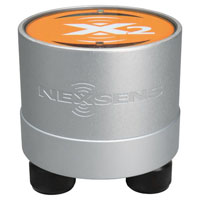
The NexSens X2 Environmental Data Logger offers the latest in real-time monitoring technology with wireless communication, large plug-and-play sensor library, and ultra-low power consumption.

The Q45S wet H2S gas detector uses the standard Q45 electronics package in conjunction with a special “Wet H2S” sensor.
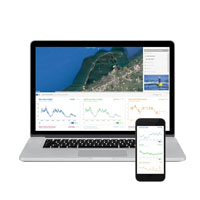
WQData LIVE is a web-based project management service that allows users 24/7 instant access to data collected from remote telemetry systems.